Packing: What Lives Where.
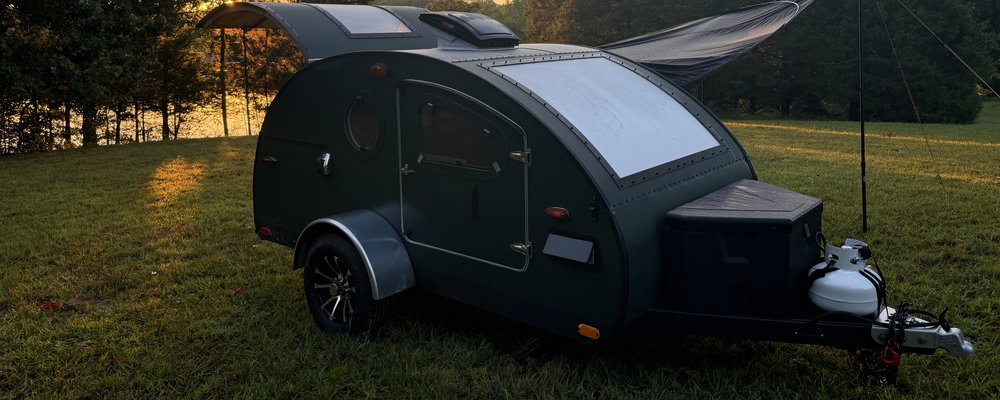
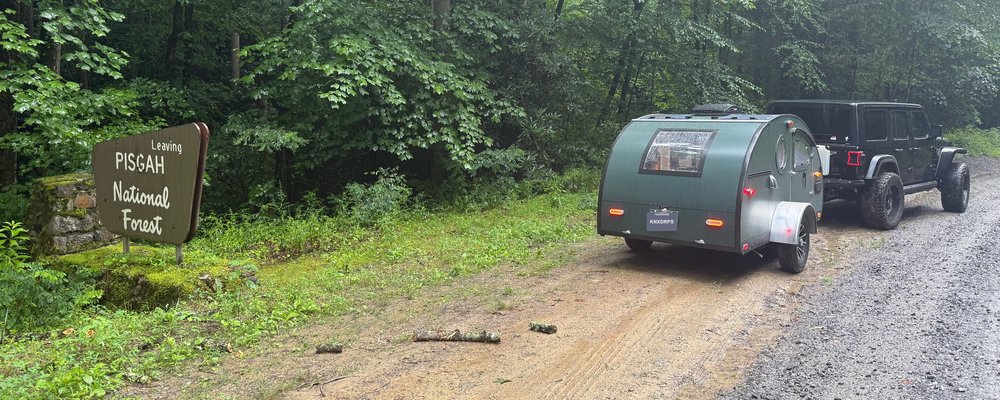
My teardrop has five places to put things: under the bed, in the tongue box, in the galley, in the cabin, and in the Jeep. Most things have an obvious spot, and when two places would both work, the tiebreaker is weight. Mine weighed 1,900 lb loaded with 200 lb on the tongue, which is toward the low end of the range, so where the heavy stuff rides isn't just about being tidy. Here's what goes where, why, and a starting list to pack from.
The Rule
Heavy things go forward of the axle and as low as they'll fit, and nothing heavy goes behind the axle if it has anywhere else to be. Light, bulky stuff goes wherever's left. That's pretty much the whole system, and it comes from the tongue weight post. The galley sits behind the axle, so every pound of cookware and food back there takes weight off the coupler, and my number is already toward the low end. Fifty pounds moved from the galley to the tongue box makes a real difference on a trailer this light.
The second rule is getting to it. Things you need on the side of the road go where you can reach them with the galley latched and the cabin full of bedding. Things you need at 2 a.m. go within arm's reach of the pillow. Things you need once a trip can be buried.
Under the Bed
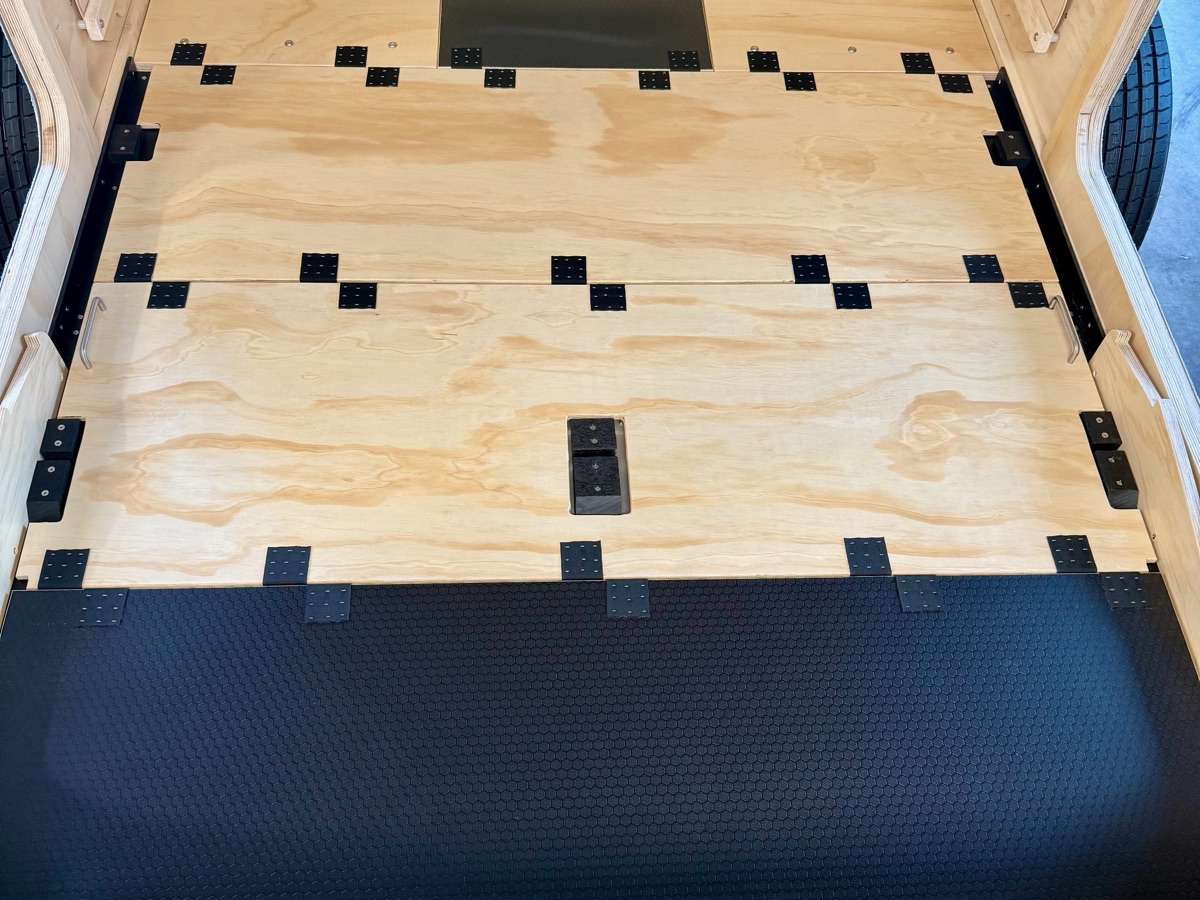
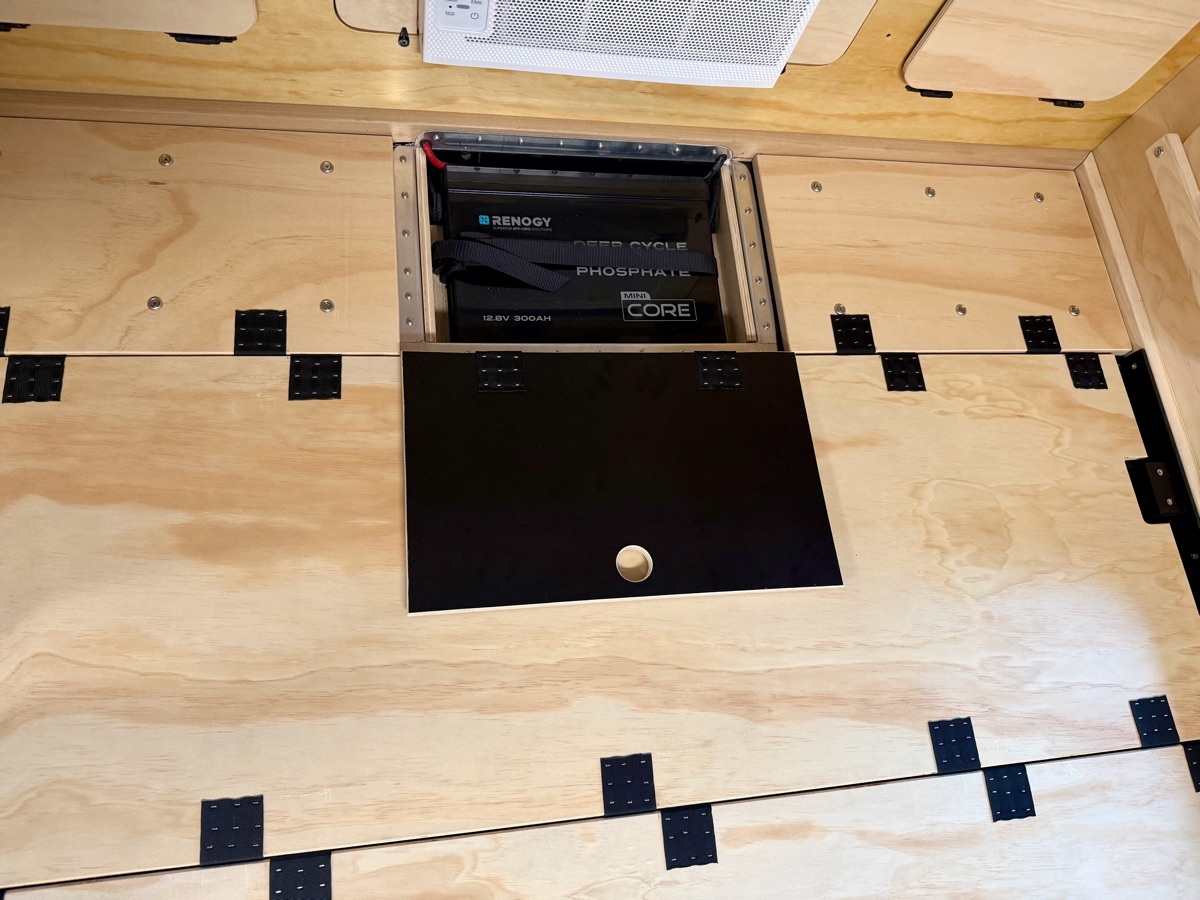
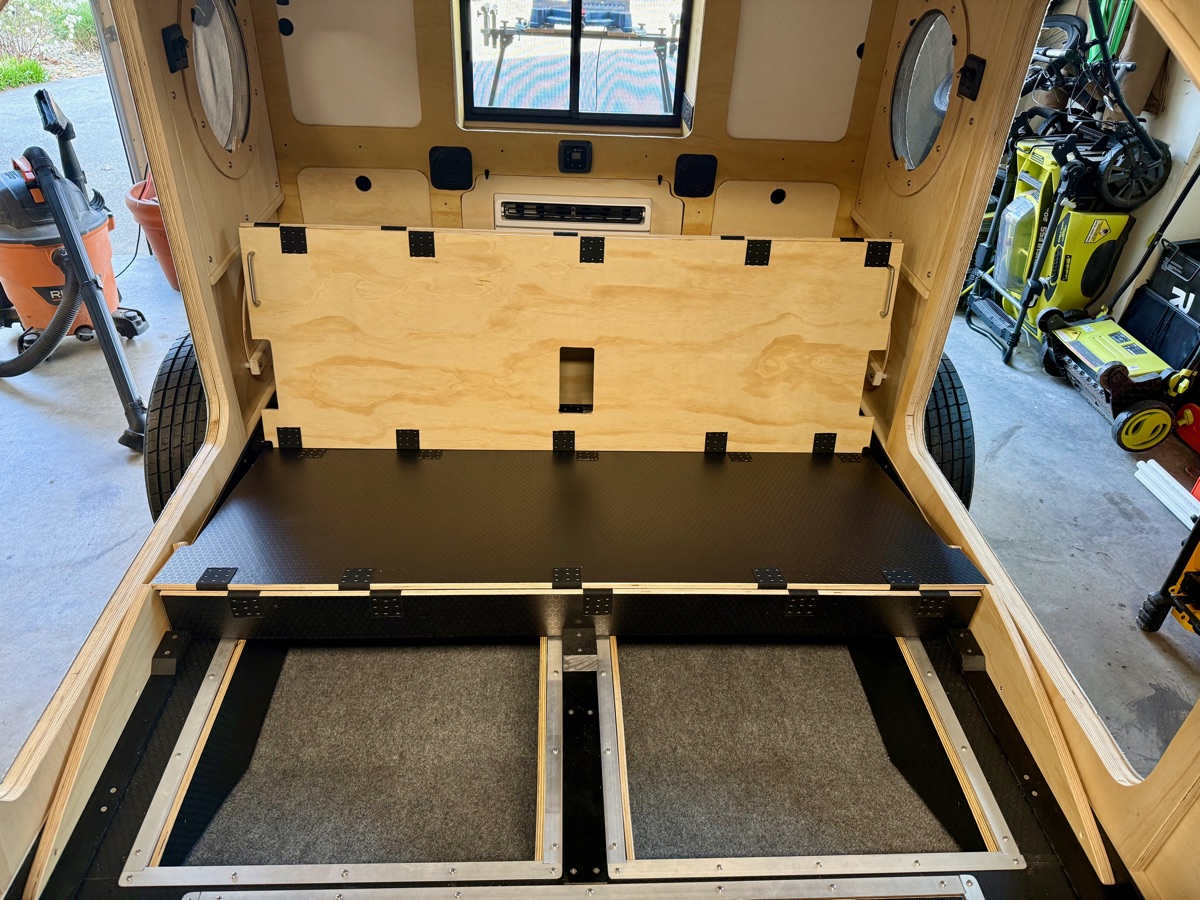
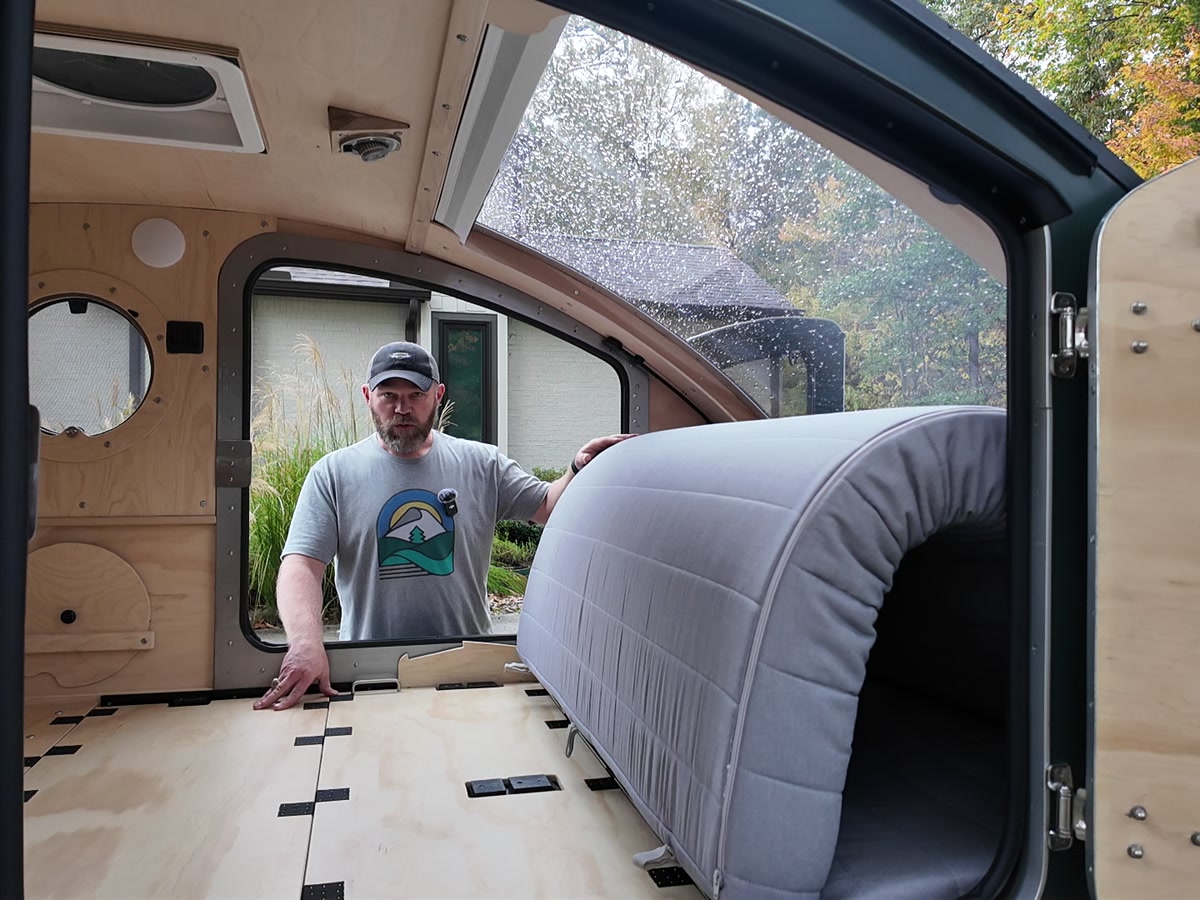
Under the mattress are lift-out plywood panels over carpeted bays. There's no insulation down there because I used it for storage instead, and it's the best storage in the trailer since it's low, central and close to the axle, so whatever goes in it barely moves the tongue number either way. That's why the battery is there. The Renogy Core Mini 300Ah weighs 55.1 lb and sits in an aluminum TIG-welded battery box that hangs under the bed, reached through a flip-up panel. I run Timbrens, so the battery box sits right in line with the axle, between the two of them.
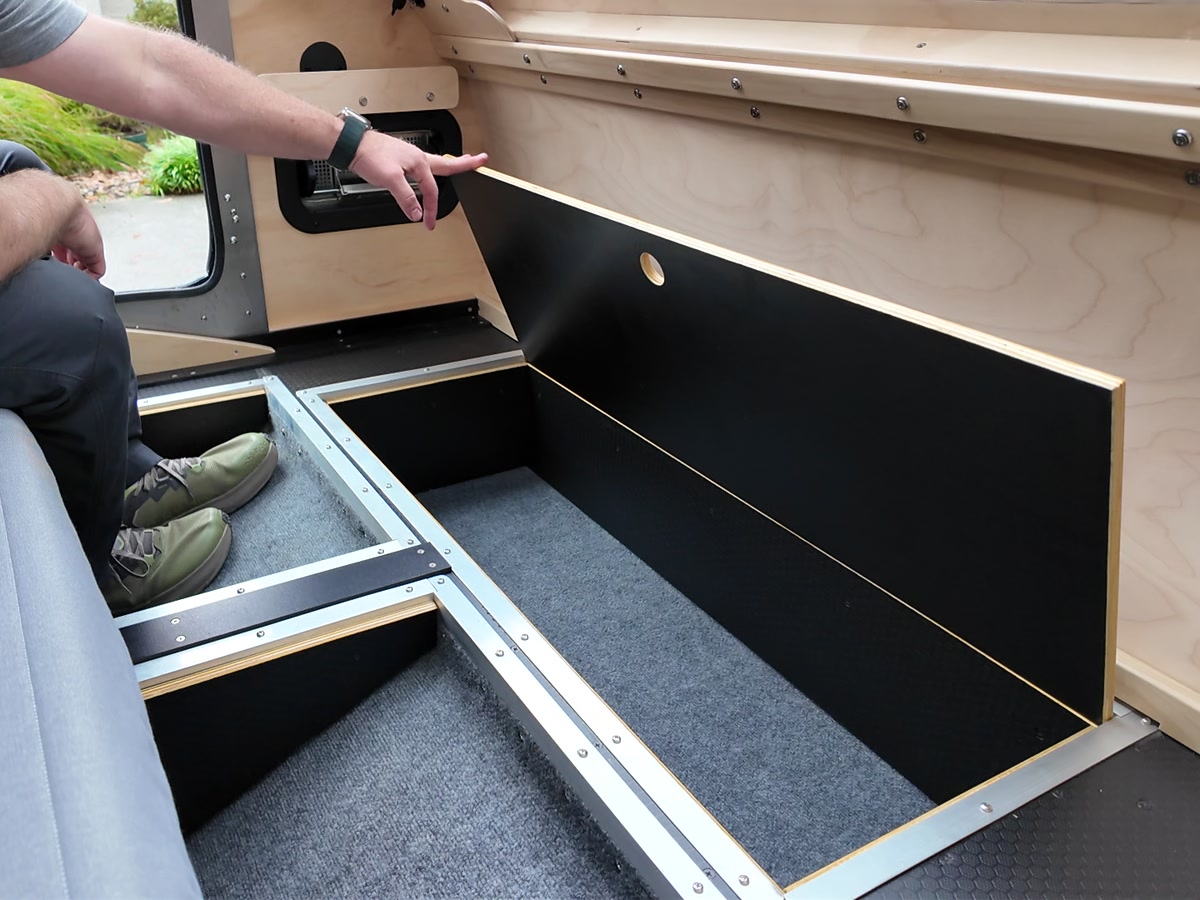
The rest of the bays are for things I don't get to very often, like bags and spare bedding. The front foot well is the easiest one to reach, so it holds the extra pillows that come out when I get ready for bed. With the bed folded up in couch mode, you sit with your feet in the foot wells, which are storage too and go all the way back, and there's another storage bay up front. You can only get to them in couch mode, so they're for things you don't get to very often. Nothing you need during the night or at a fuel stop should go there.
Two things to know about bays like these. The panels have to come up cleanly with the mattress folded back, so nothing can be packed above the panel line. And since they're the lowest point of the trailer, the bays are TIG-welded aluminum, so the water and mud a forest road throws at the underside stay on the outside.
The Tongue Box
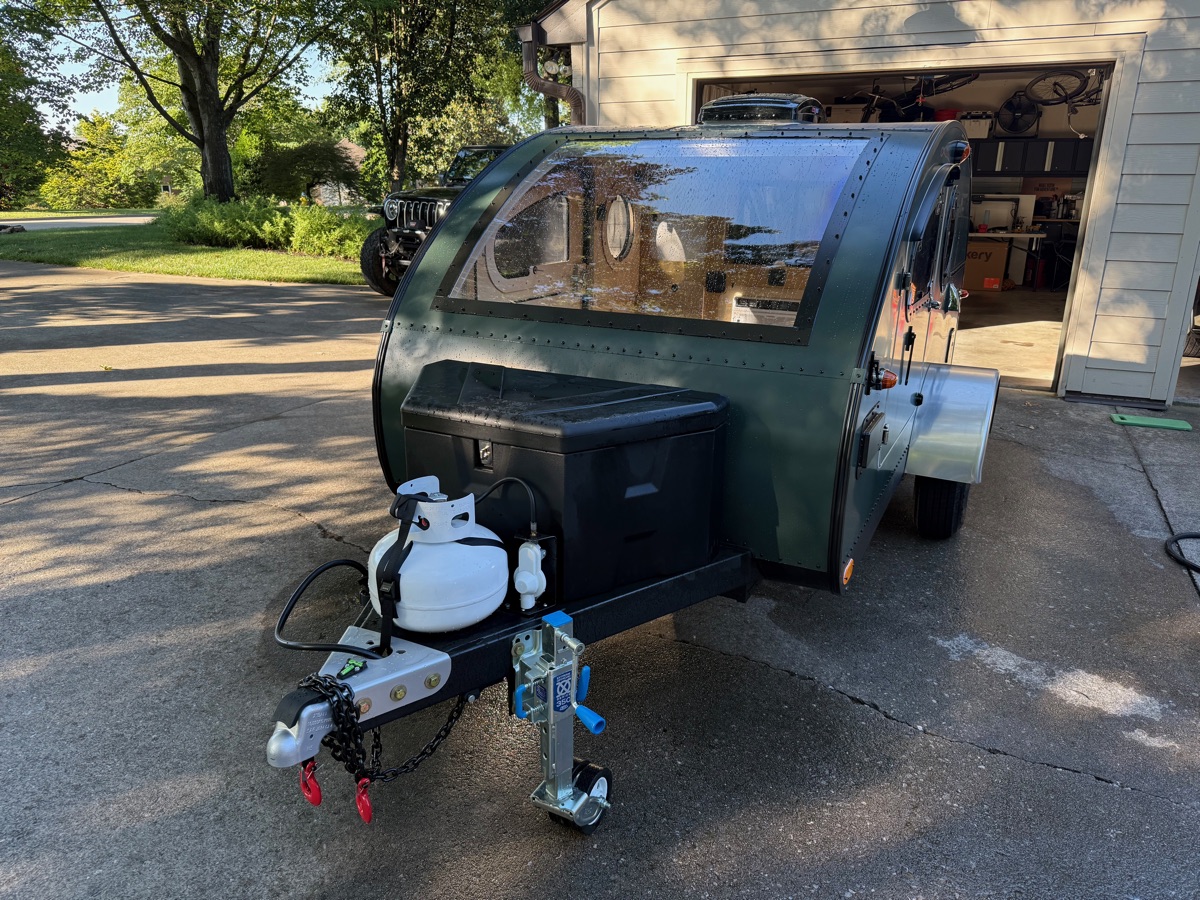
The black box on the tongue is the furthest forward storage on the trailer, and it's the only place where weight helps instead of hurts, since every pound in it is a pound on the coupler. It's also outside the cabin, which makes it the place for anything dirty, wet, or that smells like propane.
Mine carries the side tables, the chock blocks, a leveling block, the jack handle, the side and rear awnings with their poles, stakes and guy lines, the water filler spout, and the oil and fuel stabilizer for the generator with its funnel. The 11 lb propane tank rides on the tongue too, outside the box, with its two-stage regulator. A full tank weighs more than an empty one, so its share of the tongue weight drops a little over a trip, which the tongue weight post covers. The tongue box is usually the first thing opened at a site and the last thing closed.
What doesn't go in there: anything that can't take road spray, and anything worth stealing, because a tongue box lock is more of a suggestion than anything.
The Galley
Food, cookware and the fridge. That's the galley's job and that's what it holds, and since it's all behind the axle, every pound in it works against the tongue. The Dometic CFX3 35 is the one heavy thing that has to be there, about 37 lb empty and 55 to 70 lb packed for two people on a two or three day trip, sitting on its slide in the lower galley between the sliding doors. Everything else is worth picking for being light. The fridge gets packed last, once it's cooled down. The dry food goes on the shelves and in the cubbies, and there are little hidey holes and tucky places all over a teardrop, so I pack things wherever they fit. Once it's stacked in, it doesn't bounce around on the trip.
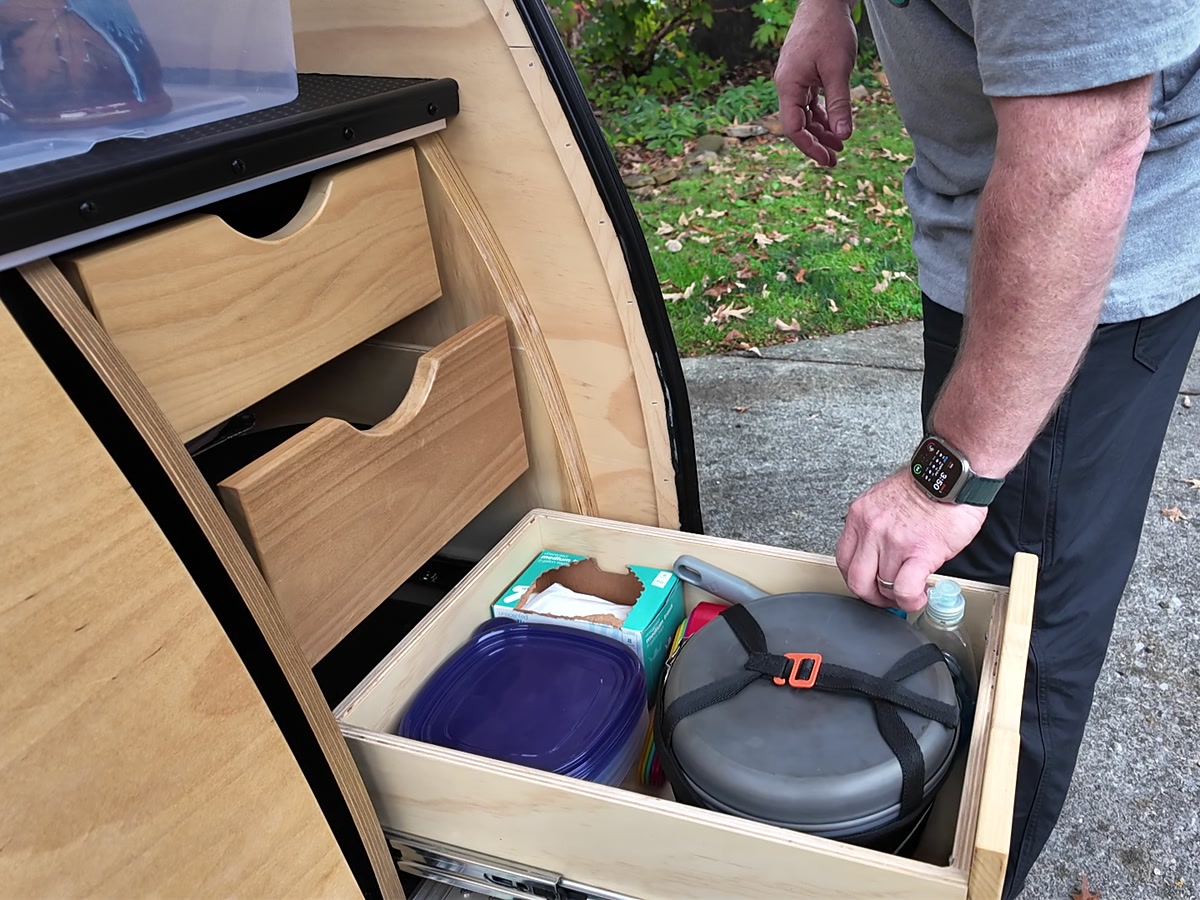
The drawers hold a lot of the cooking stuff: the nesting cookset and the Tupperware in the bottom drawer, then the dish soap, plates, a mug and the glasses. I throw a pair of gloves over the top of the glass so it doesn't bounce around and break. Equate flushable wipes are kind of a multi-tool, since I can wash dishes with them as well as clean hands and kind of bathe with them, so they go in a drawer where they're easy to get to.
For a three-day trip I only need meals for three days, so I get meals I can make once and have leftovers for: a Knorr chicken meal is dinner one night and lunch the next day. The rest is quick stuff like soups and ramen, jerky and a nut mix for snacks, and oatmeal or biscuits and gravy out of a little camp oven, plus bacon and eggs. Cooked leftovers go in Tupperware in the Dometic, so three days of packing comes to about 10 meals worth of food.
The clear bin the food rides in becomes the shoe bin later, so when you pop your shoes off at night there's somewhere to set them and you don't bring all the nasty inside.
My three drawers on the right side are 7", 6" and 5" tall from the bottom up, so the dense stuff goes in the bottom drawer where it's lowest, and the light, bulky stuff goes up top. The slides are rated at 50 lb each, just in case I have a pallet of gold bricks to haul around. Food all stays in the teardrop, put away and latched, and nothing goes in the Jeep overnight. I wrote up the bear country side of that in Bears, and a Galley Full of Food.
In the Cabin
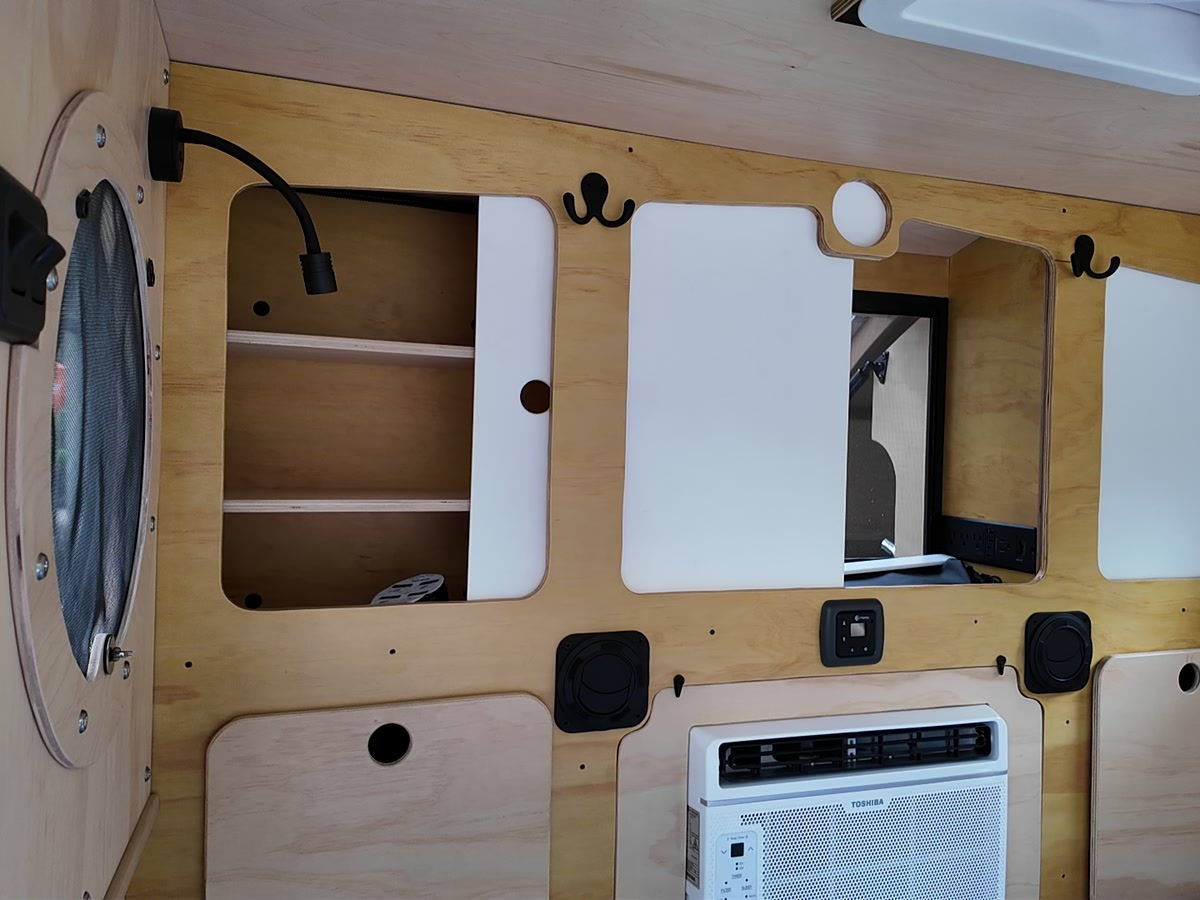
The cabin holds what you need lying down: phones and cables at the power strip in the pass-through, which has 4 outlets and 3 USB ports, 2 of them USB-C, plus a book, a water bottle, glasses, the fan remote and a headlamp. There are cubbies on the wall either side of the AC. One side holds the bedding: sleeping bags, Rumpl blankets, a woobie, things to stay warm. When it gets really cold the Propex goes on, but if it's just a little cold the blankets come out. The other side is where all my clothes pile in. Up top on both sides are sliders with shelves behind them for things I don't need all the time, like the iPad and phone. The door shades stay attached to each side door, and the front window has a slide-down blackout shade. The hatch window doesn't have a shade, but the pass-through to the galley has two sliding covers so nobody can see in, and a divider sits in their bottom track to hold them open and in place when I'm towing.
The clothes go in packing cubes. My wife rolls complete outfits together with a rubber band around each one, which is great for international travel. I'm used to camping and backpacking, so each kind of clothes gets its own cube: socks and underwear, shirts, shorts, pants, jackets. When something's dirty, I swap out just that. My camping clothes stay in their cubes between trips, so I can grab them and throw them in the camper.
The rule in the cabin is that nothing loose should be able to hurt anybody when it comes off a shelf on a rough road, so anything heavier than a book gets put away before towing. The shelves up top sit behind those sliding panels. A phone is fine. A cast iron pan is not.
Between trips I keep the bed rolled up so the floor is exposed. The MaxxAir fan and the side vents stay open, and a mattress lying flat is pretty much a big sponge holding moisture in. The bedding stays in the camper between short trips, but for the winter all of it comes out, because anything that holds moisture doesn't need to stay in there over time.
The Jeep
The Jackery lives in the Jeep with its portable solar panel, and it can run the AC for a few hours or put some charge back into the house battery. The generator rides there too when I bring it, along with the chairs, my fishing go bag, firewood, the camp stove and the Dutch oven. Food is the exception, since it stays latched in the teardrop. The full tow vehicle kit is getting its own post.
The Water Question
The heaviest single thing I carry isn't the battery. It's fresh water. I have two 9 gallon Valterra tanks, one fresh and one gray, in aluminum pans under the galley end of the frame, and 9 gallons at a little over 8 lb a gallon is about 75 lb, all of it behind the axle. As you use it, a lot of that water just moves from the fresh tank to the gray tank, so the weight back there doesn't drop as much as you'd think until you dump the gray. So the gray tank travels empty, the fresh tank travels full when there's no water where I'm going, and the CAT scale numbers were taken with the fresh tank full. Knowing which is the difference between a tongue number you can trust and one that changes at every spigot.
If you're laying out a build, that's the argument for putting the tanks ahead of the axle. Mine aren't, and the packing rules above are part of how I live with that.
A Packing List to Start From
By location, because that's how it gets packed. Use it as a starting point and change it to fit how you camp.
Where It Goes
Storage Is a Layout Decision.
Where the bays, the tongue box and the tanks go gets decided when the frame and the panels are cut. If you're ordering a frame or a kit, or having us build out a trailer you already own, it's worth talking through how you'll pack it before anything gets cut.
See Our BuildsShop This Post
These are the things from the packing list that I'd point you to first.
Disclosure: KnoxDrops is a participant in the Amazon Services LLC Associates Program. As an Amazon Associate we earn from qualifying purchases — if you buy through a link on this page, it costs you nothing extra.
← Back to Blog