Baltic Birch vs UltraLight.
The usual teardrop plywood argument is Baltic birch against marine ply, and I think it's the wrong argument. What builders really want from marine ply is one thing, a glue line that survives getting soaked, and there's now a sheet that gives you that at about two-thirds the weight. I built most of my trailer out of it, 11 sheets of UltraLight and UltraHEX. It also costs a good bit more than Baltic birch, which turns what looks like an easy upgrade into a real decision.
What You're Actually Buying
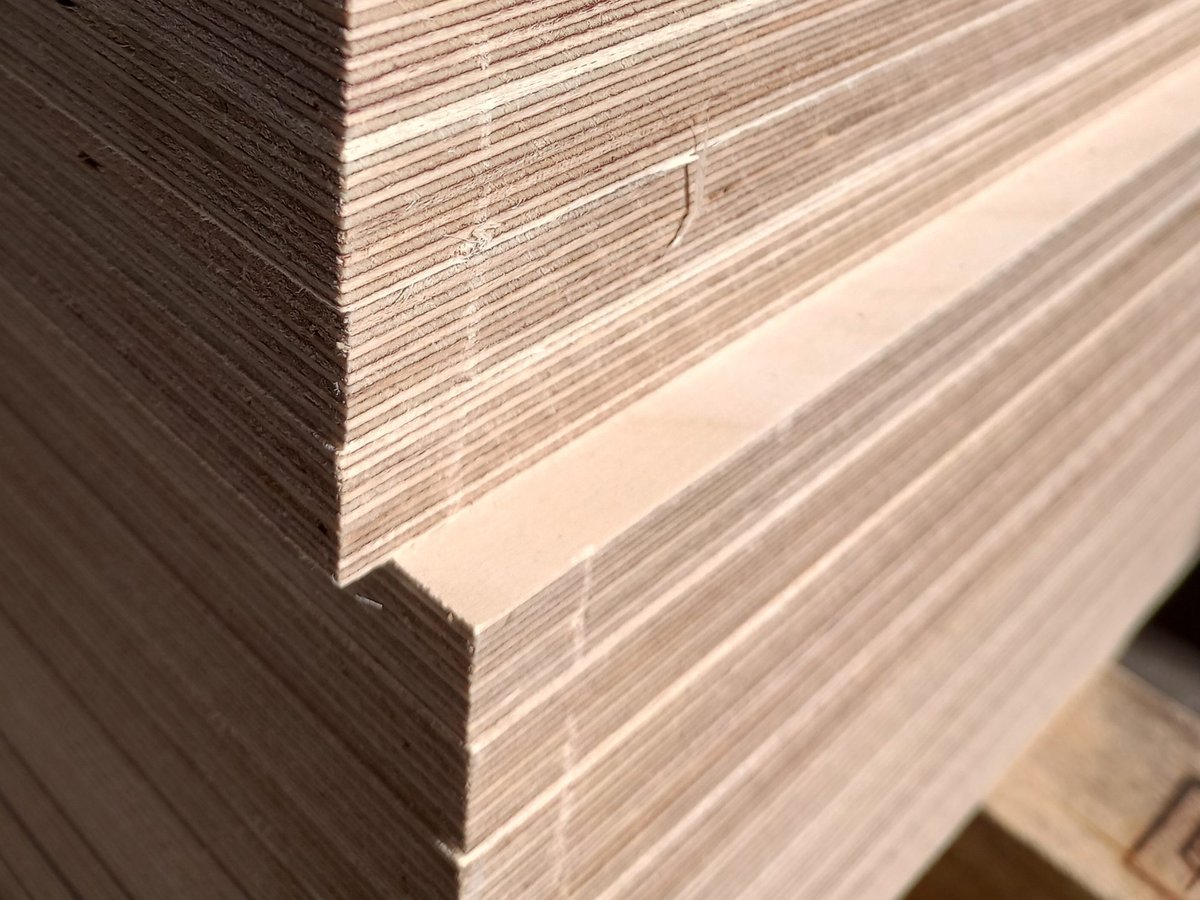
Baltic birch is a lot of thin birch plies with no voids between them, so a cut edge is a clean stack of layers instead of a row of gaps. It machines nicely and an exposed edge can actually look good. The catch is the glue. Standard Baltic birch is bonded with an interior or moisture resistant glue, so it's a great furniture panel that happens to get used outdoors a lot.
UltraLight is built around a lighter core with exterior grade glue all the way through, very few core voids, an AA face, sanded to 220 grit on both sides and calibrated to a third of a millimeter. It comes in 6mm, 12mm and 18mm, all in 48×96 sheets.
UltraHEX is the same core with WBP marine grade phenolic resin throughout and a phenolic film on both faces, hex textured on the front for grip and smooth on the back. The face is the finish, so it's the one sheet here you don't have to seal on the flat. That's why I used it for the galley floor, the cabin floor, the galley dividers, the under bed storage and the countertop.
What Marine Ply Was Really For
Marine ply gets brought into this because of its glue: WBP, weather and boil proof, a bond that doesn't let go when the sheet gets wet and stays wet. That's worth having on a trailer that lives outside.
But you pay for it in weight, on every panel, including the ones that will never see a drop of water. UltraLight's exterior glue is the same family of bond, and UltraHEX is WBP marine grade phenolic, so you get the thing people are after without hauling around the weight it used to come with.
The part that's easy to forget, whichever sheet you buy, is that none of these is waterproof wood. The glue survives water, but the wood still swells, still rots if it stays wet, and still needs sealing. Paying for the better glue and then skipping the finish only solves half the problem.
Compare by the Square Foot, Not the Sheet
This is the trap a lot of online comparisons fall into. Baltic birch is commonly sold in 5×5 sheets, which is 25 square feet, and UltraLight comes in 48×96, which is 32. Comparing one sheet to the other is comparing two different amounts of plywood, and the smaller sheet always looks lighter. Convert to pounds per square foot and you get an honest picture:
Baltic Birch, 3/4"
About 72 to 75 lb for a 48×96 sheet, roughly 2.2 to 2.3 lb per square foot depending on whose numbers you use. UltraLight's own comparison chart says 75. The baseline.
UltraLight, 18mm
51 lb per 48×96 sheet, 13 ply, which is 1.6 lb per square foot. About 30% lighter at the same thickness.
UltraHEX, 18mm
54 to 57 lb per sheet depending on the film, also 13 ply, so about 1.8 lb per square foot. The film costs three to six pounds and is a finished surface.
UltraLight, 12mm
31 lb per sheet, 9 ply, just under 1 lb per square foot, against 50 lb for Baltic birch at the same thickness. Where most non-structural panels can live.
UltraLight, 6mm
20 lb per sheet, 5 ply, 0.6 lb per square foot, against 39 lb for Baltic birch. Skins, cabinet backs and drawer bottoms.
The Build Number
Mine used 5 sheets at 3/4" and 6 at 1/2". At about 21 to 24 lb saved per 3/4" sheet and 19 lb per 1/2" sheet, that's somewhere around 200 to 230 lb, a little less since some of mine are the heavier UltraHEX. Check my math.
On my trailer, two hundred pounds is more than a full 9 gallon fresh tank, the 55 lb battery and the propane tank put together. Mine went across a CAT scale at 1,900 lb loaded against a goal of staying under 2,000. I didn't do everything I could have to keep the weight down (a steel frame, AC, propane heat and a sink will do that), so the plywood was one place I did save.
What It Costs to Save That Weight
Here's the part that makes it a decision instead of an easy yes. From my supplier, a 4×8 sheet of 3/4" UltraLight is $174 and 1/2" is $122. A 4×8 of 3/4" Baltic birch is $90.24, and the 1/2" was only in stock in 5×5 at $44.25. By the square foot that puts UltraLight at about double: $5.44 against $2.82 at 3/4", and $3.81 against $1.77 at 1/2". Across a full build that's a real line item, and it shows up right when you're also paying for a frame, a battery and an axle.
The same square foot trap shows up on price. A 5×5 of 3/4" Baltic birch was $89.59, almost the same as the 4×8, for 7 fewer square feet. That's $3.58 a square foot, and against that the gap to UltraLight shrinks to about 50%. Price it by the square foot or the comparison doesn't mean anything.
The way I'd decide is dollars per pound. At 3/4" the difference is about $84 a sheet for roughly 21 to 24 lb saved, and at 1/2" it's about $65 for around 19 lb. Either way it works out to somewhere around $3.50 to $4 for every pound you take off. If my whole build had been UltraLight that's about $800 over Baltic birch at those prices, and some of mine is UltraHEX, which costs more. Hold that up against the other ways to take weight off, some of which are free, like a thinner panel where nothing structural is going on, or carrying less water.
So it comes down to whether the weight actually matters for you. If you're close to your tow vehicle's limit or the trailer's own GVWR, or you're going to feel two hundred pounds on a mountain grade, the premium buys you something real. If you're well under every limit, it mostly buys a nicer number on a spreadsheet, and that's a fair call too.
There's a middle path too, which is spending it where the area is. Walls, floor and roof are most of the square footage, and cabinets and drawer boxes are small, so switching those saves very little.
Voids Are the Real Enemy
Both of these sheets have already solved the problem that rules out ordinary construction plywood, which is voids, the gaps in an inner ply where there's no wood at all.
They Ruin Edges
Run a round-over and a void opens up as a crater halfway along.
They Weaken Fasteners
A screw that lands in a void holds in two thin plies instead of the full thickness, and you find out when a hinge pulls loose.
They Hold Water
A void connected to a cut edge fills up, the water has nowhere to go, and the sheet delaminates from the inside.
You Can't See Them
Not when you buy, which is the whole argument for paying for a grade that doesn't have them.
Where Each One Belongs
Mixing them isn't a compromise. Mine is UltraLight for the side walls, cabin doors, bulkhead and interior cabinets, UltraHEX on the galley and cabin floors, the galley dividers, the under bed storage and the countertop, and Baltic birch for the 3mm and 6mm ceiling and roof skins, the sliding galley doors and the 1/2" drawer boxes, which have 3/4" poplar fronts. I'm still a little on the fence about UltraLight though. It's nice that it's lighter and comes sanded to 220, but I'm not sure it holds a screw as well as Baltic birch. I also did my galley backsplash and inside cabinet face in 1/2" to save space, and if I did it over I'd go 3/4". It's a game of inches building tiny, but there's a lot to be said for a solid mechanical hold.
Buying It
Mind the Sheet Size
5×5 birch against 48×96 UltraLight changes your cut layout, so plan the nest before you order.
Thickness Is the Bigger Lever
Dropping a step where a panel isn't structural can save more than switching material.
Grades Vary
"Baltic birch" covers a range. Ask what grade, and ask about the face veneer if the surface will show.
Check It Flat
A warped sheet is a warped panel. Buy in person where you can, and store sheets flat instead of leaning them on a wall.
Watch for Lookalikes
Plenty of sheets with "birch" in the name are birch faced construction ply with a voided core. The face doesn't tell you anything.
Let It Acclimate
Give sheets a few days lying flat in the shop before you cut.
On the Bench


Whichever You Buy, Seal the Edges
The most expensive sheet in the world will still drink water through a bare routed edge, glue or no glue.
Seal every cut edge, cutout and screw hole in an exterior panel before assembly, since it's a lot easier flat on a bench. I like water based poly for interior parts and use oil based where water and sun actually hit. I hate that oil based stuff, but it's the right call there, and the poly post has the rest.
Where the Pounds Went
The plywood was one place I saved weight. The tongue weight post has what the whole trailer came out to on a CAT scale, and how I checked the tongue at home.
Read the Tongue Weight PostShop This Post
The plywood comes from a lumber supplier, not Amazon. These are what I seal it with, the same ones from the poly post.
Disclosure: KnoxDrops is a participant in the Amazon Services LLC Associates Program. As an Amazon Associate we earn from qualifying purchases — if you buy through a link on this page, it costs you nothing extra.
← Back to Blog