Tongue Weight, and Why Teardrops Forgive You.
Most teardrops tow beautifully, and most owners never measure their tongue weight. Those two facts are related, and they're both a bit of a trap. A short, low, light trailer hides loading mistakes that would have a bigger trailer swaying at 60 — right up until you add a battery at the front, a full water tank at the back, and a hundred pounds of gear in the galley, and discover the margin was doing all the work. Here's how to measure it, what the number should be, and what actually moves it.
What the Number Means
Tongue weight is the downward force the coupler puts on the hitch ball with the trailer level and loaded the way you actually travel. It is not the trailer's weight, and it is not a fixed property of the trailer — it's a consequence of where you put things relative to the axle.
The working target is 10 to 15% of the loaded trailer weight. Underneath that range the trailer starts to steer the tow vehicle instead of following it, which is how sway begins. Above it you're levering weight off the tow vehicle's front axle, which costs you steering and braking exactly when you need both.
The reason it matters less on a teardrop than on a travel trailer is leverage. A 3,000lb box with twelve feet behind the axle can generate enough force to move a truck. A 1,600lb teardrop with four feet behind the axle mostly can't. That's real forgiveness, and it's also why the mistake goes unnoticed until conditions get bad — a crosswind on I-40, a passing semi, a downhill grade with a loaded galley.
Tongue Weight Eats Your Payload
Here's the part that catches people who did everything else right. Tongue weight doesn't just press on the hitch — it counts against your tow vehicle's payload, the same allowance that carries passengers, dogs, coolers and whatever is in the bed. Every pound at the coupler is a pound you can't put in the truck.
The numbers you want are on the sticker in the driver's door jamb, not in the brochure. Tow rating is the figure marketing quotes; payload is the one that usually runs out first, and it's frequently far lower than owners expect on a well-optioned vehicle. Four adults, a full tank, a dog and 180lb of tongue weight can put a half-ton over its payload while the trailer is still nowhere near its tow rating.
It's rarely a problem with a teardrop, which is exactly the point of one. But it's worth doing the sum once rather than assuming, particularly if you tow with something small — a compact SUV's payload disappears faster than its tow rating does.
Measuring It Without a Scale
You don't need a truck stop scale. A bathroom scale and a piece of lumber will get you within a few percent, which is far more useful than the guess you're working from now.
1. Load It for Real
Water in the tank, battery in place, galley packed, gear where it lives on a trip. An empty trailer's number tells you nothing you can use.
2. Get It Level
Coupler at the same height it sits at when hitched. Measure it on a slope and the number is wrong in a direction you can't predict.
3. Build the Lever
A board with a brick under one end and the bathroom scale under the other, coupler resting at a measured point in between.
4. Do the Arithmetic
Scale reading multiplied by the ratio of the distances. Coupler at the midpoint means double the reading; a third of the way along from the brick means triple it. The calculator below does it for you.
5. Weigh the Whole Trailer
You need the loaded total to turn pounds into a percentage. A CAT scale trip costs a few dollars and settles it.
6. Write It Down
Note the number and what was loaded where. It's the baseline you'll compare against after you change anything.
A worked example: coupler resting halfway along a four-foot board, scale reading 90lb. Tongue weight is roughly 180lb. On a 1,500lb loaded trailer that's 12% — comfortably inside the range, and nothing to change.
Work Out Your Number
Measure from the brick, which is the pivot. Distances can be inches or centimetres — only their ratio matters, so use the same unit for both.
Nothing here is sent anywhere — the arithmetic runs in your browser.
Doing It Properly at a Scale
The board method is close enough to act on. If you want the real number — and you'll want it once, to check that your improvised version isn't lying — a public scale gives you everything in two passes and about ten minutes.
Pull on fully loaded and hitched, and weigh the whole combination. Note the figure. Then unhitch, leave the trailer off the scale on its jack, and weigh the tow vehicle alone. The difference between the two is your tongue weight, because that's the load the trailer was transferring to the vehicle.
While you're there, weigh the trailer by itself to get the loaded total. Now you have both halves of the percentage and you never have to estimate it again for that loading. Note what was in the trailer and where, because the number belongs to that configuration and not to the trailer in general.
Worth doing at the start of a season, and again after any change big enough to argue about — a new battery, a water tank, a rack.
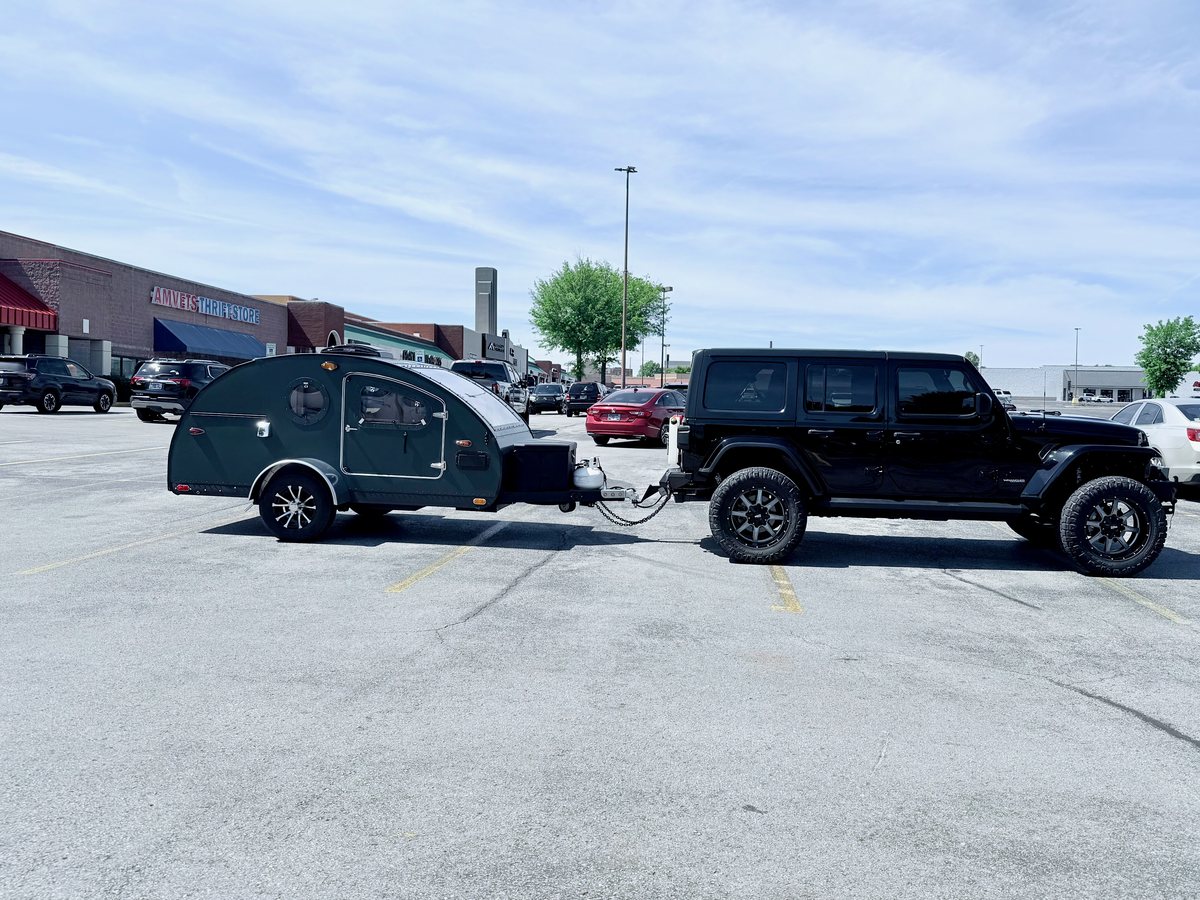
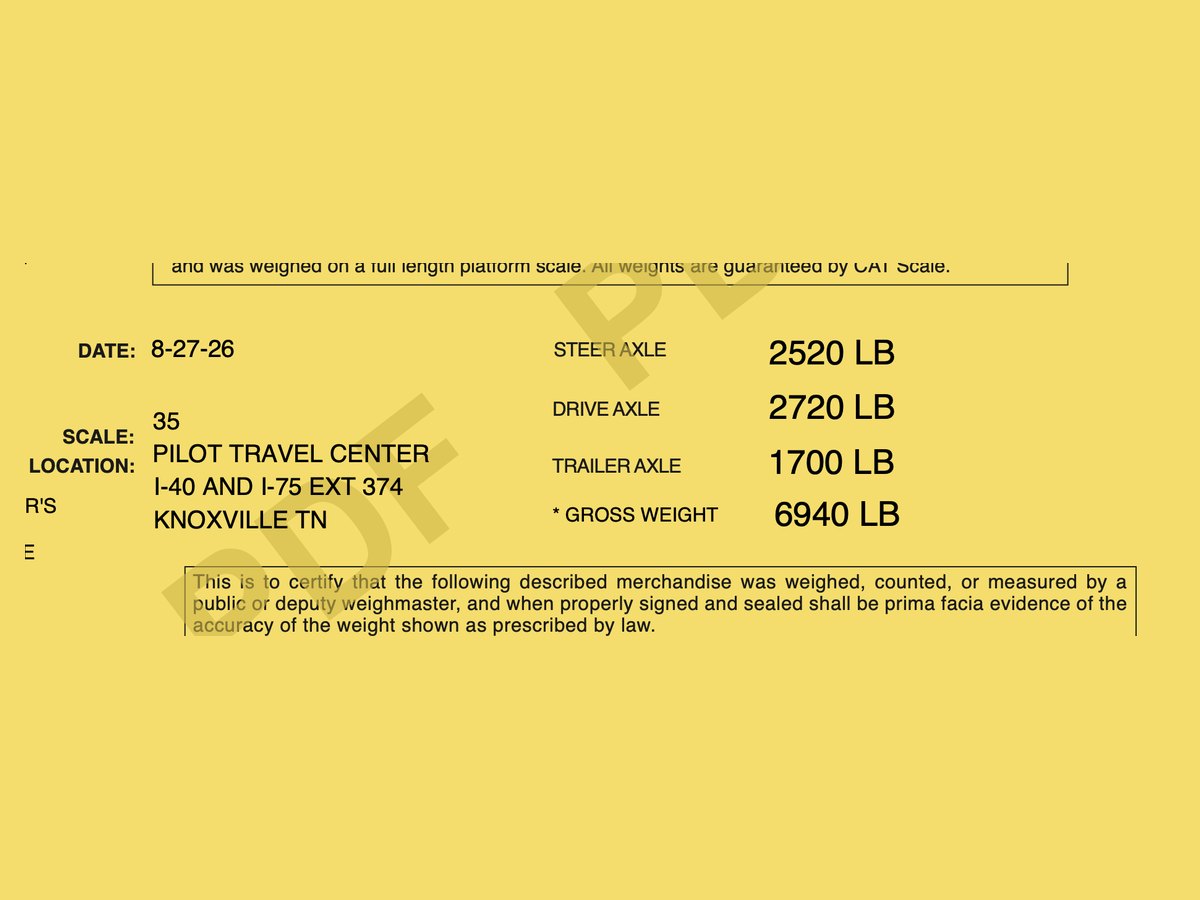
Our own numbers, from two passes over a CAT scale outside Knoxville: hitched and loaded, the combination came to 6,940 lb, with 1,700 lb of that on the trailer axle. The tow vehicle alone weighed 5,040 lb. Subtract it from the combination and the loaded trailer is 1,900 lb; subtract the trailer axle from that and 200 lb is sitting on the ball. That's 10.5% — inside the range, but at the bottom of it, which is what we'd expect from a build with the galley behind the axle.
The second pass tells you something the percentage doesn't. Hitching moved 300 lb onto the tow vehicle's drive axle and took 100 lb off the steer axle — a net 200 lb added, but redistributed. That lever, weight lifted off the front wheels of the vehicle doing the steering, is the reason the upper end of the range has a limit at all.
What Actually Moves It
On a teardrop, four things dominate, and three of them are heavy items you get to choose the location of.
The Battery
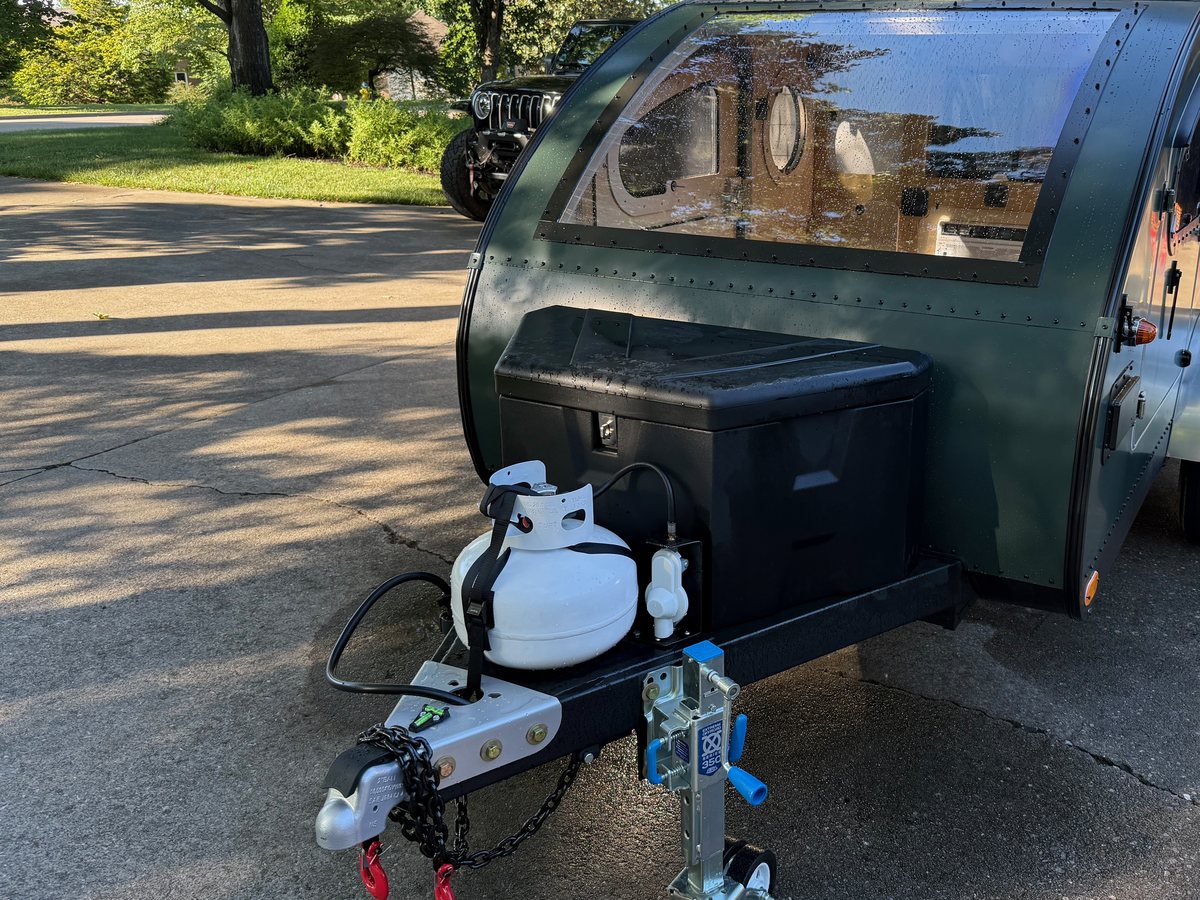
The single biggest lever. A lithium bank is lighter than lead, but either one sitting in a front tongue box adds tongue weight directly, pound for pound.
Water
Eight pounds a gallon, and it lives wherever you put the tank. Twenty gallons behind the axle can pull meaningful weight off the tongue.
The Galley
Everything in the galley is behind the axle, and it's where the heaviest gear ends up — fridge, cookware, food, tools.
The Propane Bottle
Usually on the tongue, usually forgotten in the sums, and it changes as it empties.
Bikes and Racks
A rear rack is the fastest way to take a well-loaded trailer out of range. Two bikes hung off the back is exactly the wrong place for that weight.
Where You Sleep
Not while towing, obviously — but the mattress, bedding and interior storage all sit near the axle, which is why they matter less than people assume.
The Axle Decides It Before You Load Anything
Everything above is about redistributing weight around a fixed axle. But where that axle sits under the trailer sets the baseline, and it's decided once, at the frame stage, by whoever builds it.
Move the axle rearward and tongue weight goes up, because more of the trailer's mass sits ahead of the pivot. Move it forward and tongue weight drops, along with your margin for anything you load behind it. Builders generally place it so an empty trailer lands a little above the target percentage, on the reasoning that most of what gets added afterwards — galley gear, water, bikes — sits behind the axle and will pull the number back down.
If you're speccing a frame rather than buying a finished trailer, this is the conversation worth having up front. A trailer built for someone carrying twenty gallons of water and a rear rack wants its axle in a different place than one built for weekend trips with a cooler. It's a cheap decision at the drawing stage and an expensive one afterwards.
Reading the Symptoms
Numbers are better, but the trailer will tell you first if you know what you're feeling for.
Sway that starts and doesn't stop is the one to treat as urgent. Ease off the throttle, keep the wheel steady rather than correcting into it, and go and load the trailer differently before the next leg. Sway is a loading problem the great majority of the time, not a driving one.
Fixing It
In order of what to try first, because the cheap fixes are also the effective ones.
Move the Heavy Things
Free, immediate, and usually sufficient. Water forward, dense gear over or ahead of the axle, nothing heavy hung off the back.
Repack the Galley
Tools and cast iron toward the front of the bay, light bulky items to the rear. Same total weight, different number at the coupler.
Reconsider the Rack
If bikes have to travel, they belong on the tow vehicle rather than behind the axle of a short trailer.
Check Hitch Height
A nose-high or nose-low trailer shifts load between axles and changes how the whole thing behaves. Get it level first, then measure.
Relocate the Battery
A real job, but it's the biggest single adjustment available if loading changes aren't enough.
Then Look at the Hitch
Weight-distribution and anti-sway hardware exist, and are rarely the right answer on a trailer this light. Fix the loading first.
The Thirty-Second Version
You won't put a scale under the coupler before every trip, and you don't need to. Once you know your baseline number, the pre-trip check is a look rather than a measurement:
One more reason to know your loaded weight: it decides whether your trailer is required to have brakes. Tennessee sets the line by gross weight — under 1,500 lb no brakes are required, from 1,500 to 3,000 lb brakes are required on one axle, and at 3,000 lb and above on all wheels, with a breakaway device on any trailer that has brakes (TCA 55-9-204, as the Highway Patrol's trailer inspection sheet spells it out). At 1,900 lb loaded, ours sits in the middle band. Thresholds vary by state, so check the ones you tow through rather than assuming Tennessee's numbers travel with you.
Behind the Rig
Ordering a Frame?
Axle placement is the one decision that sets your tongue weight before anything is loaded. We build trailer frames to order and it's worth talking through where the axle should sit for how you plan to camp.
See Our BuildsShop This Post
The board and the bathroom scale you already own. What's here is what makes the number easier to get, and easier to trust, once you care about it more than once a year.
Disclosure: KnoxDrops is a participant in the Amazon Services LLC Associates Program. As an Amazon Associate we earn from qualifying purchases — if you buy through a link on this page, it costs you nothing extra.
← Back to Blog