The Roof Fan Does More Than You'd Think.
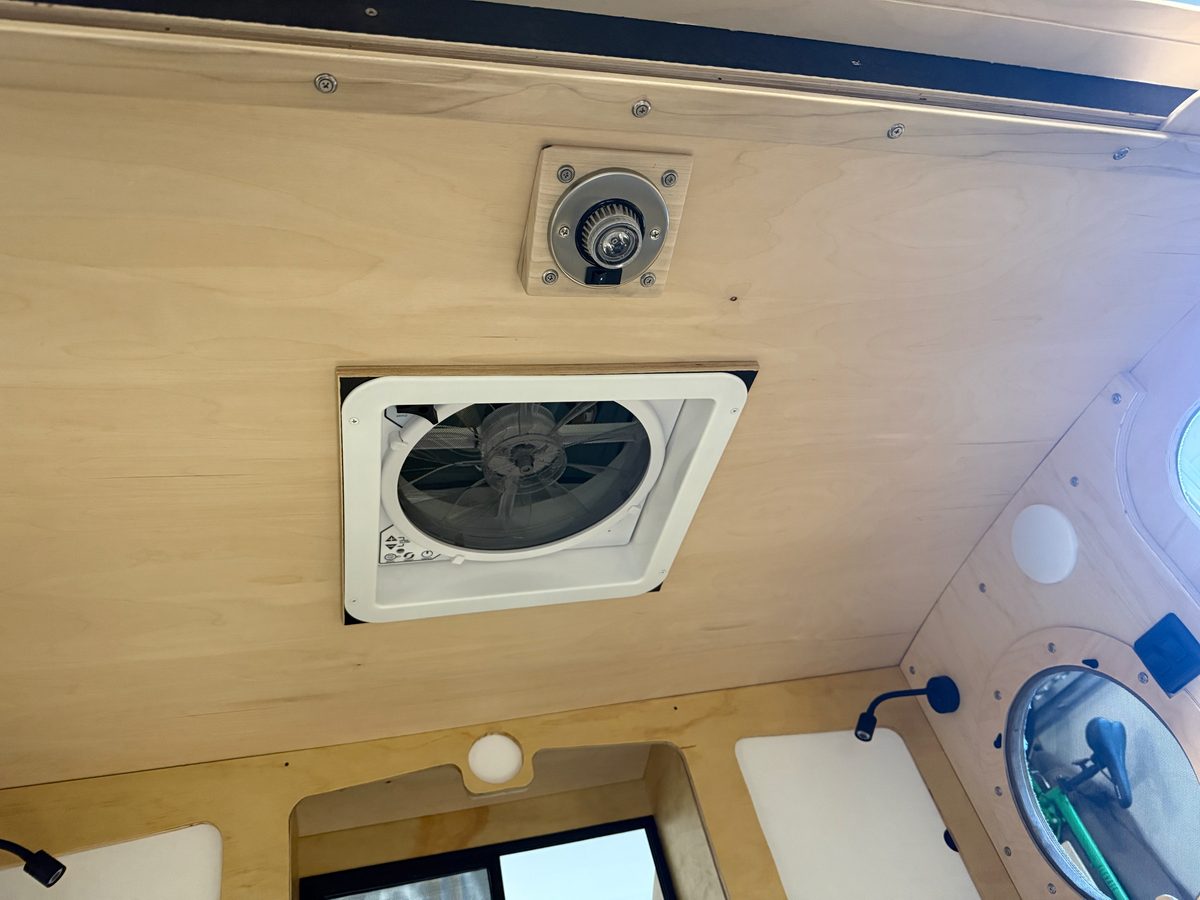
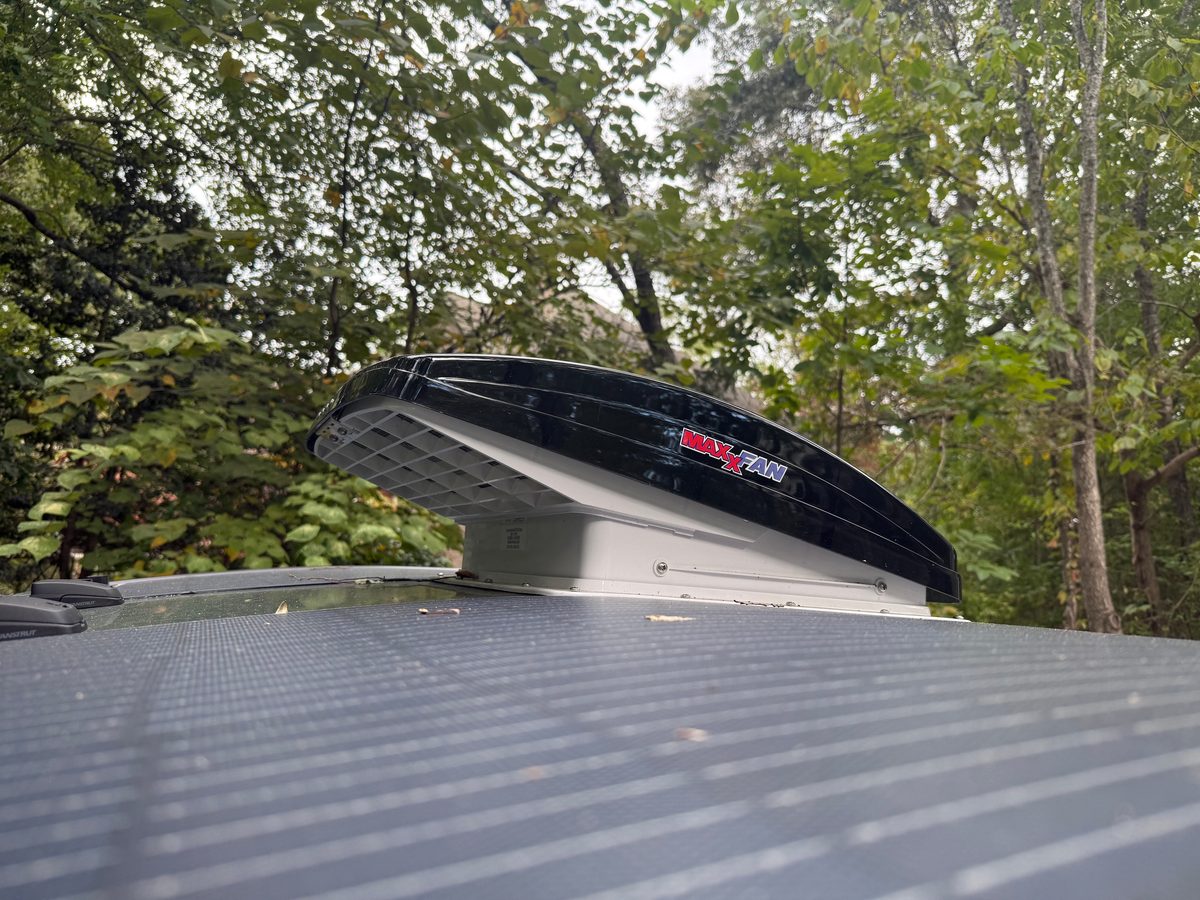
Ask people what they'd add to a teardrop first and most of them will say the fridge. Ask what they'd give up last and a lot of them say the roof fan. Next to everything else in a build it's cheap, it barely touches the battery, and on a July night in a closed up box it's the difference between sleeping and lying there sweating. Mine is a MaxxFan Deluxe 7500K that sits between my two solar panels, and it also does a second job that has nothing to do with being comfortable.
Summer Is the Obvious Reason
A teardrop is a small box, and on a hot afternoon it acts like an oven. Mine only has rigid foam in the roof, and that foam does a good job of slowing down the heat coming through the aluminum skin, but once the heat is inside, the same foam slows it getting back out. The only thing that really gets rid of it is moving air.
A roof fan pulling air out with a window cracked or a lower vent open at the other end sets up a flow through the whole cabin, and it does it in minutes instead of hours. That's the difference between a cabin you can lie down in at nine o'clock and one you're waiting on until midnight.
Which way it blows matters more than people expect. Exhaust, pulling air out the top and drawing cooler air in low through a window or a door, is the setup for a hot night, since the hot air is already up at the ceiling waiting to leave. Intake, blowing outside air in, is handy on a cool morning when you want to push the stale air out in a hurry.
The Fan, the AC, and the Propex
I also have a 6k BTU Toshiba window unit on a shelf in the middle cabinet and a Propex HS2000 furnace right below it, so it's fair to ask why I'd bother with a fan at all. The short answer is the AC needs shore power. At a site with a hookup it handles the muggy nights, and the Jackery that lives in the Jeep can run it for a few hours if I need it to, but that's about the end of it. Elkmont has no hookups and neither does a forest road in Pisgah, so on a lot of nights the fan is the cooling system.
The Propex covers the other end. It's a room-sealed furnace, which means it pulls its combustion air from outside and sends its exhaust back outside, so it doesn't add water to the cabin the way an unvented propane heater would. That's one of the best things about it. It doesn't do anything about the water two people breathe out overnight though, and that's where the fan comes back in.
So the way it shakes out is the AC for hot nights with power, the Propex for cold nights, and the fan for everything in between and as a backup for both. It's also the cheapest of the three to run by a long way.
The Job Nobody Buys It For
Two adults asleep in a closed cabin put out a surprising amount of water vapor overnight, along with the carbon dioxide you'd expect. In a tight, well built teardrop neither one has anywhere to go, which is the funny part about building one well.
That vapor finds the coldest surface it can and condenses there. In a build like mine, with foam only in the roof, that's going to be the plexiglass/acrylic windows and the walls, and the inside of the hatch if it gets the chance. Let that happen night after night over a season and you get staining, and eventually you get damp inside a wall that looked perfect when you built it.
Running the fan on low overnight with a window cracked an inch moves enough air to carry that moisture out. It feels backwards on a cold night with the furnace running, since you're heating a little outside air you just let in on purpose, but it's the cheapest thing you can do to keep the cabin dry. It's worth thinking of the fan as part of the insulation instead of a comfort accessory.
What to Look For
Reversible
In and out. Worth having, and most decent fans do both.
A Rain Lid
The feature that matters most in the Smokies. The Deluxe has a built-in rain cover, so the fan keeps running through a summer thunderstorm instead of you closing everything up and stewing.
Variable Speed
Low is the setting you'll actually use overnight. A fan with only one loud setting gets switched off, and then it's not doing either job.
Low Draw on Low
It's sharing the battery with the fridge. A fan that sips on its lowest setting can run all night and you'll never notice it.
A Bug Screen
You want one in Tennessee in the summer, and it's a lot easier to have it built in than to add one later.
Thermostat and Remote
Nice, not essential. The 7500K has both, and a remote at two in the morning beats crawling across the mattress to reach the switch.
On the power side, the 7500K is rated at about 0.2 amps on low and around 4.5 amps on high. Ten hours on low overnight is about 2 Ah. Ten hours on high, which nobody would want to sleep through, is about 45 Ah, or roughly what my Dometic CFX3 uses in a whole day at 38–43 Ah. That's on a 300Ah Renogy battery with 200 watts of solar on the roof, so on low the fan is a rounding error. Check my math, but I'm comfortable calling it free.
Living With It
Low, Almost Always
High is for clearing the cabin out fast. Overnight, low is quiet enough to sleep through.
Crack a Window
A fan with nowhere to pull air from just works harder. One window open an inch at the far end does more than turning the speed up.
Watch the Bugs
An interior light and an open vent at dusk is an invitation. Screen closed and light off first, then open it up.
Clean the Screen
It clogs up with dust and pollen over a season and the airflow drops off without you noticing why.
Close It to Tow
Obvious until the one time it isn't. Add it to whatever walk-around you already do before pulling out.
Check the Seal Every Spring
It's the biggest hole in your roof. Look over the sealant once a year along with the rest of your maintenance.
A fan that runs most of the time also turns out to be a pretty good canary for the rest of the 12V system. On a weekend at the lake I was standing at the galley cleaning up after lunch when I heard my fan stop. Since I'd planned and built the electrical myself, my first thought was that either the switch had gone bad or the relay that connects the battery to my distribution block had moved on to a farm in Vermont. It turned out to be a loose main wire on the positive distribution block, and once I tightened the nut on that lug everything came back. Either way, it was the fan going quiet that told me something was up.
Cutting the Hole
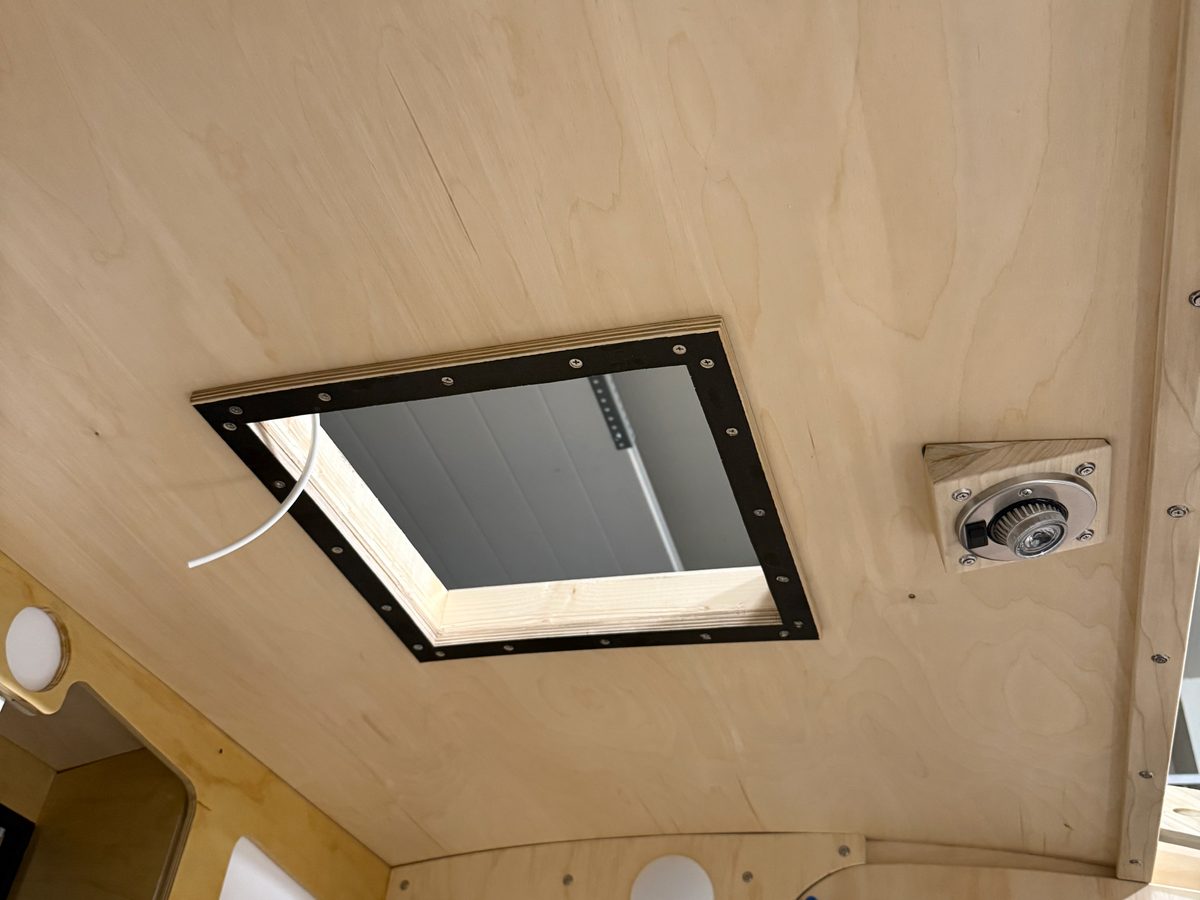
Everything above is easy. Cutting a 14 inch square hole in the roof of a trailer you just spent weeks making watertight is not, and it's the part worth being slow about. Measure, measure again, then go get a coffee and come back and measure one more time.
Measure against the roof framing from inside before you cut, not just from the outside. A fan that's perfectly centered on the roof and lands on a rib underneath is a bad afternoon. Plan it at the same time as the solar and anything else going through the roof, because it all wants the same strip along the top. On mine the fan sits between two Renogy 100W flexible panels, and each panel has its own Scanstrut cable seal, so that's five things on one curved roof that all needed room.
Then seal it right. The usual way is butyl tape under the flange and a lap sealant that's made for your roof material over the edges and the screw heads. Go look at it after the first hard rain instead of assuming. When a roof fan leaks it's almost always the install and not the fan.
On the Roof

Sizing the Power?
The fan is a small load that runs all night, which makes it worth counting. The wiring diagram builder sizes the battery around everything you plan to run.
Open the Wiring Diagram BuilderShop This Post
The fan is the one on my roof. The other two are the usual way to seal one in.
Disclosure: KnoxDrops is a participant in the Amazon Services LLC Associates Program. As an Amazon Associate we earn from qualifying purchases — if you buy through a link on this page, it costs you nothing extra.
← Back to Blog